The primary purpose of the Intergovernmental Panel for Climate Change (IPCC) is to assess the available scientific knowledge about climate change, not to initiate new research. The next IPCC report (Assessment Report 4, or AR4) is due in 2007, and in order to update of the state of knowledge it will only consider papers published in peer-review scientific journals between 2000 and papers submitted by May 1st 2005 (must be accepted before December 2005). It is essential that the papers be published in scientific quality journals in order to ensure the credibility of the results. Nevertheless the IPCC reports undergo several additional reviews and revisions involving a large number of independent referees. Thus, the IPCC reports undergo a more stringent review process than common papers in the scientific literature.
Climate Science
IPCC in action: Part I
This is the first of two pieces on the recent IPCC workshop in Hawaii, This brought together independent researchers from all over the world to analyse computer model simulations of the last 150 years and to assess whether they are actually any good.
Guest commentary from Natassa Romanou (Columbia University)
During the first 3 days of March 2005, balmy downtown Honolulu in Hawaii was buzzing with agile scientists conversing, chatting, announcing, briefing and informing about IPCC assessment reports, climate models, model evaluations, climate sensitivities and feedbacks. These were the participants of the Climate Model Evaluation Project workshop (CMEP) and came here from most (if not all) the major, most prestigious climate research laboratories of the world, including; The US labs National Center for Atmospheric Research, the Geophysical Fluid Dynamics Laboratory and the Goddard Institute for Space Studies, the British Hadley Centre for Climate Prediction, the German Max Planck Institute for Meteorology, the Canadian Centre for Climate Modelling and Analysis, the French Centre National de Recherches Meteorologiques and the IPSL/LMD/LSCE, the Australian CSIRO Atmospheric Research, the Chinese Institute of Atmospheric Physics, the Russian Institute for Numerical Mathematics and the Japanese Meteorological Research Institute. This meeting was sponsored by the benevolent NSF, NOAA, NASA and DOE.
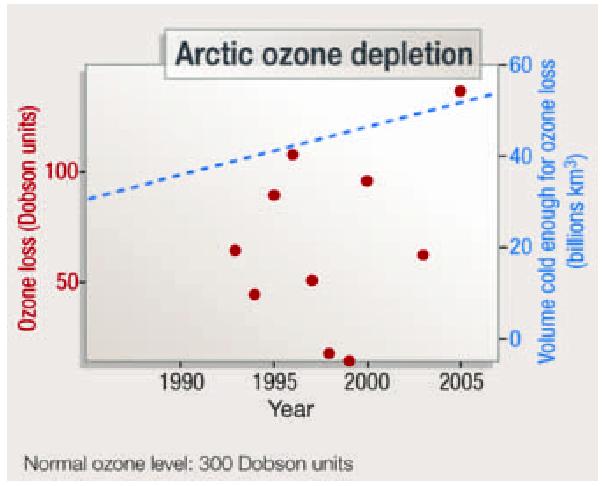
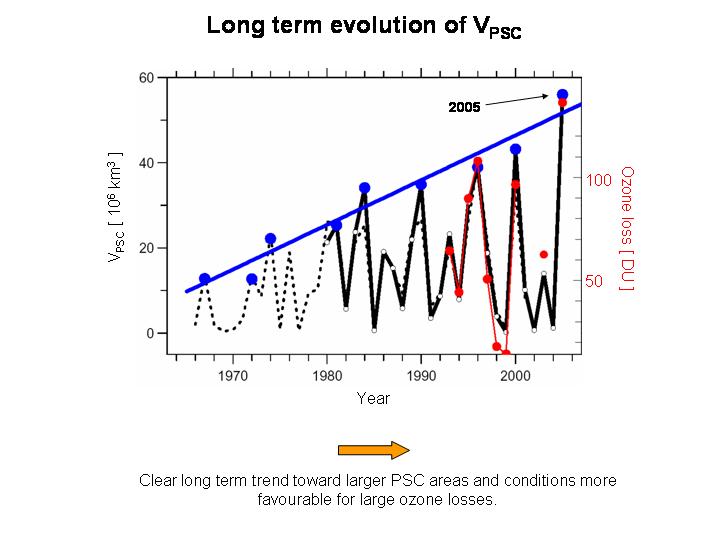
Will spring 2005 be a bad one for Arctic ozone? Le printemps 2005 comptera-t-il parmi les mauvais pour l’ozone arctique ?
Guest Commentary by Drew Shindell (NASA GISS)
The current winter and early spring have been extremely cold in the Arctic stratosphere, leading to the potential for substantial ozone depletion there. This has been alluded to recently in the press (Sitnews, Seattle Post Intelligencer), but what’s the likely outcome, and why is it happening?
Par Drew Shindell, NASA, GISS (traduit par Pierre Allemand)
L’hiver actuel et le début du printemps ont été extrêmement froids dans la stratosphère arctique, ce qui est un facteur de réduction substantielle de l’ozone dans cette région. La presse a récemment fait allusion à ce phénomène, (Sitnews, Seattle Post Intelligencer),mais quels sont, en fait, les résultats, et qu’est-ce qui fait que cela arrive ?
The Last Word for Now…
Of possible interest to our readers, there was an interview yesterday on the BBC (“Today Programme”) regarding the supposed controversy about the “Hockey Stick”: A climate scientist Professor Michael Mann suggests global warming is caused by mankind (mp3 file). Also available on the BBC website is the real audio file of the interview.
How rapid-response works
Nature this week published a letter from Dr. Huang (U. Mich) highlighting how this ‘brave new world’ of science blogging works. He writes:
I was concerned to find that … [a figure] included an outdated and erroneous reconstruction of borehole data. … In my view, the website should have used a later version … To be fair, the authors of the website added a correction after I drew their attention to this.
In an early post, we used a figure that contained a minor error regarding how a borehole temperature reconstruction had been scaled. This mistake had been properly corrected in the literature, and so this was indeed an oversight on our part. Dr Huang was kind enough to remind us of this and we amended the caption immediately to point this out and direct readers to the correction should they be interested. Since this mistake was not central to the point being made in the post, we left the original figure in place.
The Internet is nothing if not flexible, and unlike in journals where mistakes can persist an awfully long time, we are able to correct such problems very quickly. In this respect, Dr. Huang’s letter seems to indicate that things are actually working quite well here.
We would like to take this opportunity to re-iterate our commitment to getting the science right, and as importantly, getting it right in real-time. We welcome all corrections or clarifications and we will endeavour to fix any errors, great or small, as quickly as we can.
RealClimate
Why looking for global warming in the oceans is a good idea Voici pourquoi rechercher le réchauffement global dans les océans est pertinent
A lot of press and commentary came out this week concerning a presentation and press release from Tim Barnett and Scripps colleagues presenting at the AAAS meeting (The Independent, John Fleck ,(and again) David Appell…etc). Why did this get so much attention given that there is no actual paper yet?
Un grand nombre d’articles de presse et de commentaires sont sortis cette semaine concernant une présentation et un communiqué de presse de Tim Barnett, Scripps et collègues au congrès de l’AAAS (American Society for the Advancement of Science), (The Independent, John Fleck ,(et de nouveau ici) David Appell…etc. (NdT : sites en anglais). Pourquoi cela a-t-il donné lieu à autant d’attention, alors qu’aucune publication n’est encore disponible ?
Dummies guide to the latest “Hockey Stick” controversy Guide pratique pour comprendre la dernière controverse sur la « crosse de hockey »
by Gavin Schmidt and Caspar Amman
Due to popular demand, we have put together a ‘dummies guide’ which tries to describe what the actual issues are in the latest controversy, in language even our parents might understand. A pdf version is also available. More technical descriptions of the issues can be seen here and here.
This guide is in two parts, the first deals with the background to the technical issues raised by McIntyre and McKitrick (2005) (MM05), while the second part discusses the application of this to the original Mann, Bradley and Hughes (1998) (MBH98) reconstruction. The wider climate science context is discussed here, and the relationship to other recent reconstructions (the ‘Hockey Team’) can be seen here.
NB. All the data that were used in MBH98 are freely available for download at ftp://holocene.evsc.virginia.edu/pub/sdr/temp/nature/MANNETAL98/ (and also as supplementary data at Nature) along with a thorough description of the algorithm.
Suite à la demande populaire, nous avons écrit un « guide pratique » qui essaie de décrire quels sont les problèmes débattus dans la dernière controverse sur la “crosse de hockey”, dans un langage que même nos parents peuvent comprendre. Des descriptions techniques complémentaires sur ces problèmes peuvent être trouvées ici et ici.
Ce guide comporte deux parties, la première concerne le fond des questions techniques soulevées par McIntyre and McKitrick (2005) (MM05), tandis que la seconde partie traite de ses applications à la reconstitution de Mann, Bradley et Hughes (1998) (MBH98). Le contexte plus large de la science du climat est discuté ici et les relations avec les récentes autres reconstitutions (« l’équipe de hockey ») sont traitées ici.
NB. Toutes les données utilisées dans le MBH98 sont librement téléchargeables sur ftp://holocene.evsc.virginia.edu/pub/sdr/temp/nature/MANNETAL98/ (ainsi que des données supplémentaires dans Nature) et une description complète de l’algorithme).
[Read more…] about Dummies guide to the latest “Hockey Stick” controversy
People in, people out
This is just to note some personnel changes at RealClimate. Amy Clement is unfortunately too overcommitted to be able to participate as much as she would like, and so is dropping out of the team. She states: “I fully support what the contributors of RealClimate are doing. It is a real service to both the community of climate scientists and to the general public”. To balance that, we welcome aboard paleoceanographer Thibault de Garidel (Rutgers) , who some francophiles may have noticed has been helping organise the French translations of some of the posts. And of course, if there are any other scientists out there who’d like to contribute, we would love to hear from you.
Moberg et al: Highly variable Northern Hemisphere temperatures? Moberg et coll. : une plus grande variabilité climatique passée dans l’Hémisphere Nord ?
by William Connolley and Eric Steig
The 10th Feb edition of Nature has a nice paper “Highly variable Northern Hemisphere temperatures reconstructed from low- and high-resolution proxy data” by Anders Moberg, DM. Sonechkin, K Holmgren, NM Datsenko, & W Karlin (doi:10.1038/nature03265). This paper takes a novel approach to the problem of reconstructing past temperatures from paleoclimate proxy data. A key result is a reconstruction showing more century-scale variability in mean Northern Hemisphere temperatures than is shown in previous reconstructions. This result will undoubtedly lead to much discussion and further debate over the validity of previous work. The result, though, does not fundamentally change one of the most discussed aspects of that previous work: temperatures since 1990 still appear to be the warmest in the last 2000 years.
L’édition du 10 février de Nature contient un intéressant article “Les grandes variations de températures de l’hémisphère Nord reconstituées à partir d’observations à basse et haute résolution ” par Anders Moberg, DM Sonechkin, K Holmgren, NM Datsenko, et W Karlin (doi:10.1038/nature03265). Cet article adopte une nouvelle approche du problème de la reconstitution des températures passées à partir de marqueurs (“proxies”) des paléoclimats. Un des principaux résultats est une reconstitution montrant une variabilité à l’échelle du siècle dans les moyennes des températures de l’hémisphère nord plus importante que celle montrée dans les reconstitutions précédentes. Ce résultat amènera sans doute beaucoup de discussions et de débats futurs concernant la validité des travaux précédents. Néanmoins, le résultat ne change pas fondamentalement un des aspects les plus discutés de ces travaux, à savoir que les températures depuis 1990 semblent être les plus chaudes des 2000 dernières années.
(suite…)
[Read more…] about Moberg et al: Highly variable Northern Hemisphere temperatures?
A disclaimer Mise au point
Readers of the Feb. 14th, 2005 Wall Street Journal may have gotten the impression that RealClimate is in some way affiliated with an environmental organisation. We wish to stress that although our domain is being hosted by Environmental Media Services, and our initial press release was organised for us by Fenton Communications, neither organization was in any way involved in the initial planning for RealClimate, and have never had any editorial or other control over content. Neither Fenton nor EMS has ever paid any contributor to RealClimate.org any money for any purpose at any time. Neither do they pay us expenses, buy our lunch or contract us to do research. All of these facts have always been made clear to everyone who asked (see for instance: http://www.sciencemag.org/content/vol306/issue5705/netwatch.shtml).
Les lecteurs du Wall Street Journal du 14 fév. 2005 ont pu avoir l’impression que RealClimate pourrait être associé à une organisation environnementale. Nous souhaitons préciser que bien que notre domaine soit hébergé par “Environmental Media Services”, et le communiqué de presse initial a été organisé par “Fenton Communications”, aucune de ces deux organisations n’était de quelque façon impliquée dans la planification initiale du site RealClimate, et n’a jamais eu quelque contrôle éditorial ou tout autre. Ni Fenton, ni EMS n’ont jamais payé aux auteurs de RealClimate.org quoique ce soit. Ni l’un ni l’autre ne nous ont rémunérés ou financent notre recherche. Tous ces faits toujours ont été clairement communiqué à quiconque le demandait (voyez par exemple: http://www.sciencemag.org/content/vol306/issue5705/netwatch.shtml ).