• Skip to primary navigation
  • Skip to main content
  • Skip to primary sidebar
  • Skip to footer

RealClimate

Climate science from climate scientists...

  • Start here
  • Model-Observation Comparisons
  • Miscellaneous Climate Graphics
  • Surface temperature graphics
You are here: Home / Archives for Climate Science / Oceans

Oceans

Going with the wind

17 Feb 2014 by group

A new paper in Nature Climate Change out this week by England and others joins a number of other recent papers seeking to understand the climate dynamics that have led to the so-called “slowdown” in global warming. As we and others have pointed out previously (e.g. here), the fact that global average temperatures can deviate for a decade or longer from the long term trend comes as no surprise. Moreover, it’s not even clear that the deviation has been as large as is commonly assumed (as discussed e.g. in the Cowtan and Way study earlier this year), and has little statistical significance in any case. Nevertheless, it’s still interesting, and there is much to be learned about the climate system from studying the details.

Several studies have shown that much of the excess heating of the planet due to the radiative imbalance from ever-increasing greenhouses gases has gone into the ocean, rather than the atmosphere (see e.g. Foster and Rahmstorf and Balmaseda et al.). In their new paper, England et al. show that this increased ocean heat uptake — which has occurred mostly in the tropical Pacific — is associated with an anomalous strengthening of the trade winds. Stronger trade winds push warm surface water towards the west, and bring cold deeper waters to the surface to replace them. This raises the thermocline (boundary between warm surface water and cold deep water), and increases the amount of heat stored in the upper few hundred meters of the ocean. Indeed, this is what happens every time there is a major La Niña event, which is why it is globally cooler during La Niña years. One could think of the last ~15 years or so as a long term “La-Niña-like” anomaly (punctuated, of course, by actual El Niño (like the exceptionally warm years 1998, 2005) and La Niña events (like the relatively cool 2011).

A very consistent understanding is thus emerging of the coupled ocean and atmosphere dynamics that have caused the recent decadal-scale departure from the longer-term global warming trend. That understanding suggests that the “slowdown” in warming is unlikely to continue, as England explains in his guest post, below. –Eric Steig

Guest commentary by Matthew England (UNSW)

For a long time now climatologists have been tracking the global average air temperature as a measure of planetary climate variability and trends, even though this metric reflects just a tiny fraction of Earth’s net energy or heat content. But it’s used widely because it’s the metric that enjoys the densest array of in situ observations. The problem of course is that this quantity has so many bumps and kinks, pauses and accelerations that predicting its year-to-year path is a big challenge. Over the last century, no single forcing agent is clearer than anthropogenic greenhouse gases, yet zooming into years or decades, modes of variability become the signal, not the noise. Yet despite these basics of climate physics, any slowdown in the overall temperature trend sees lobby groups falsely claim that global warming is over. Never mind that the globe – our planet – spans the oceans, atmosphere, land and ice systems in their entirety.

This was one of the motivations for our study out this week in Nature Climate Change (England et al., 2014)  With the global-average surface air temperature (SAT) more-or-less steady since 2001, scientists have been seeking to explain the climate mechanics of the slowdown in warming seen in the observations during 2001-2013. One simple way to address this is to examine what is different about the recent decade compared to the preceding decade when the global-mean SAT metric accelerated. This can be quantified via decade-mean differences, or via multi-decadal trends, which are roughly equivalent if the trends are more-or-less linear, or if the focus is on the low frequency changes.

[Read more…] about Going with the wind

References

  1. G. Foster, and S. Rahmstorf, "Global temperature evolution 1979–2010", Environmental Research Letters, vol. 6, pp. 044022, 2011. http://dx.doi.org/10.1088/1748-9326/6/4/044022
  2. M.A. Balmaseda, K.E. Trenberth, and E. Källén, "Distinctive climate signals in reanalysis of global ocean heat content", Geophysical Research Letters, vol. 40, pp. 1754-1759, 2013. http://dx.doi.org/10.1002/grl.50382
  3. M.H. England, S. McGregor, P. Spence, G.A. Meehl, A. Timmermann, W. Cai, A.S. Gupta, M.J. McPhaden, A. Purich, and A. Santoso, "Recent intensification of wind-driven circulation in the Pacific and the ongoing warming hiatus", Nature Climate Change, vol. 4, pp. 222-227, 2014. http://dx.doi.org/10.1038/nclimate2106
Filed Under: Climate modelling, Climate Science, El Nino, Instrumental Record, Oceans

The global temperature jigsaw

17 Dec 2013 by Stefan

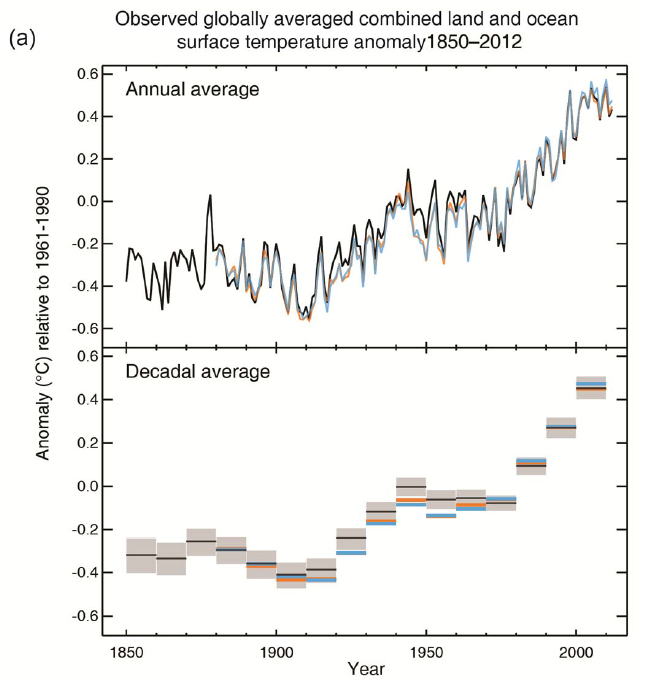
Since 1998 the global temperature has risen more slowly than before. Given the many explanations for colder temperatures discussed in the media and scientific literature (La Niña, heat uptake of the oceans, arctic data gap, etc.) one could jokingly ask why no new ice age is here yet. This fails to recognize, however, that the various ingredients are small and not simply additive. Here is a small overview and attempt to explain how the different pieces of the puzzle fit together.

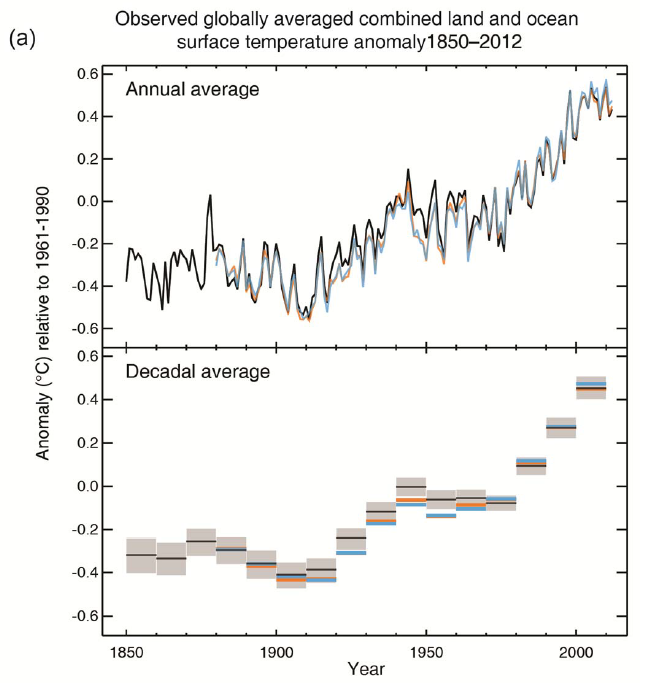
AR5_temp_obs

Figure 1 The global near-surface temperatures (annual values at the top, decadal means at the bottom) in the three standard data sets HadCRUT4 (black), NOAA (orange) and NASA GISS (light blue). Graph: IPCC 2013. [Read more…] about The global temperature jigsaw

Filed Under: Aerosols, Climate modelling, Climate Science, El Nino, Instrumental Record, Oceans, statistics

Sea-level rise: What the experts expect

23 Nov 2013 by Stefan

In the long run, sea-level rise will be one of the most serious consequences of global warming. But how fast will sea levels rise? Model simulations are still associated with considerable uncertainty – too complex and varied are the processes that contribute to the increase. A just-published survey of 90 sea-level experts from 18 countries now reveals what amount of sea-level rise the wider expert community expects. With successful, strong mitigation measures, the experts expect a likely rise of 40-60 cm in this century and 60-100 cm by the year 2300. With unmitigated warming, however, the likely range is 70-120 cm by 2100 and two to three meters by the year 2300.
[Read more…] about Sea-level rise: What the experts expect

Filed Under: Climate Science, IPCC, Oceans

Sea level in the 5th IPCC report

15 Oct 2013 by Stefan

What is happening to sea levels? That was perhaps the most controversial issue in the 4th IPCC report of 2007. The new report of the Intergovernmental Panel on Climate Change is out now, and here I will discuss what IPCC has to say about sea-level rise (as I did here after the 4th report).

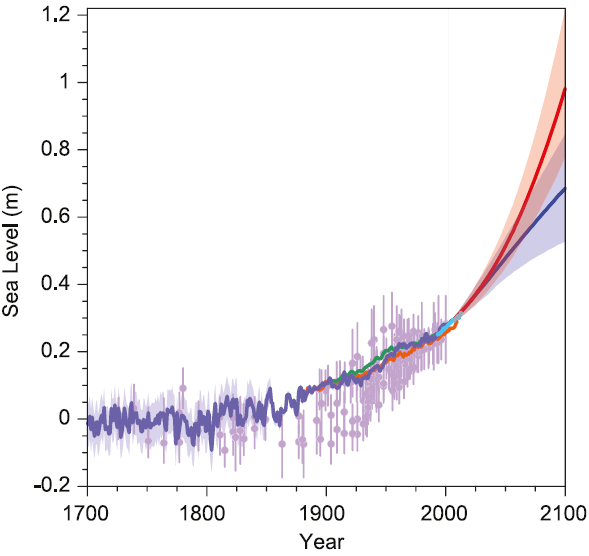
Let us jump straight in with the following graph which nicely sums up the key findings about past and future sea-level rise: (1) global sea level is rising, (2) this rise has accelerated since pre-industrial times and (3) it will accelerate further in this century. The projections for the future are much higher and more credible than those in the 4th report but possibly still a bit conservative, as we will discuss in more detail below. For high emissions IPCC now predicts a global rise by 52-98 cm by the year 2100, which would threaten the survival of coastal cities and entire island nations. But even with aggressive emissions reductions, a rise by 28-61 cm is predicted. Even under this highly optimistic scenario we might see over half a meter of sea-level rise, with serious impacts on many coastal areas, including coastal erosion and a greatly increased risk of flooding.

IPCC_AR5_13.27
Fig. 1. Past and future sea-level rise. For the past, proxy data are shown in light purple and tide gauge data in blue. For the future, the IPCC projections for very high emissions (red, RCP8.5 scenario) and very low emissions (blue, RCP2.6 scenario) are shown. Source: IPCC AR5 Fig. 13.27.
[Read more…] about Sea level in the 5th IPCC report

Filed Under: Climate Science, Communicating Climate, IPCC, Oceans

The new IPCC climate report

27 Sep 2013 by Stefan

The time has come: the new IPCC report is here! After several years of work by over 800 scientists from around the world, and after days of extensive discussion at the IPCC plenary meeting in Stockholm, the Summary for Policymakers was formally adopted at 5 o’clock this morning. Congratulations to all the colleagues who were there and worked night shifts. The full text of the report will be available online beginning of next week. Realclimate summarizes the key findings and shows the most interesting graphs.

Update 29 Sept: Full (un-copyedited) report available here.

Portuguese translation available here

Global warming

It is now considered even more certain (> 95%) that human influence has been the dominant cause of the observed warming since the mid-20th century. Natural internal variability and natural external forcings (eg the sun) have contributed virtually nothing to the warming since 1950 – the share of these factors was narrowed down by IPCC to ± 0.1 degrees. The measured temperature evolution is shown in the following graph.

Figure 1 The measured global temperature curve from several data sets. Top: annual values. ​​Bottom: averaged values ​​over a decade.
[Read more…] about The new IPCC climate report

Filed Under: Arctic and Antarctic, Carbon cycle, Climate impacts, Climate modelling, Climate Science, Greenhouse gases, IPCC, Oceans, Paleoclimate

What ocean heating reveals about global warming

25 Sep 2013 by Stefan

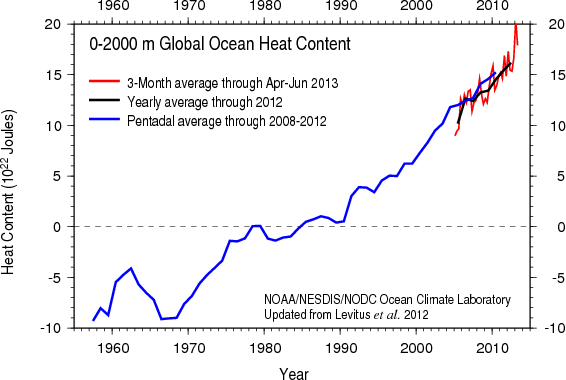
The heat content of the oceans is growing and growing.  That means that the greenhouse effect has not taken a pause and the cold sun is not noticeably slowing global warming.

NOAA posts regularly updated measurements of the amount of heat stored in the bulk of the oceans.  For the upper 2000 m (deeper than that not much happens) it looks like this:

heat_content2000m

Change in the heat content in the upper 2000 m of the world’s oceans. Source: NOAA


[Read more…] about What ocean heating reveals about global warming

Filed Under: Climate modelling, Climate Science, El Nino, Instrumental Record, Oceans, skeptics

The answer is blowing in the wind: The warming went into the deep end

26 Apr 2013 by rasmus

There has been an unusual surge of interest in the climate sensitivity based on the last decade’s worth of temperature measurements, and a lengthy story in the Economist tries to argue that the climate sensitivity may be lower than previously estimated. I think its conclusion is somewhat misguided because it missed some important pieces of information (also see skepticalscience’s take on this story here).

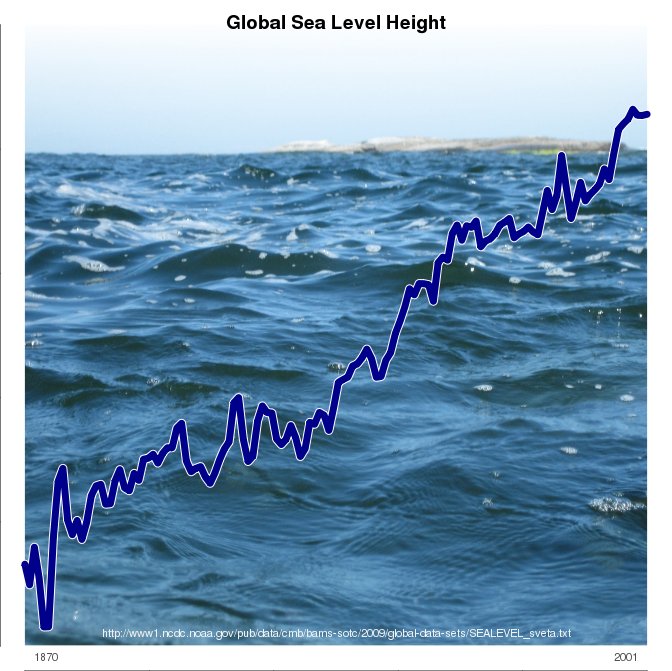
The ocean heat content and the global mean sea level height have marched on.

While the Economist referred to some unpublished work, it missed a new paper by Balmaseda et al. (2013) which provides a more in-depth insight. Balmaseda et al suggest that the recent years may not have much effect on the climate sensitivity after all, and according to their analysis, it is the winds blowing over the oceans that may be responsible for the ‘slow-down’ presented in the Economist.

[Read more…] about The answer is blowing in the wind: The warming went into the deep end

References

  1. M.A. Balmaseda, K.E. Trenberth, and E. Källén, "Distinctive climate signals in reanalysis of global ocean heat content", Geophysical Research Letters, vol. 40, pp. 1754-1759, 2013. http://dx.doi.org/10.1002/grl.50382

Filed Under: Climate impacts, Climate modelling, Climate Science, El Nino, Greenhouse gases, In the News, Instrumental Record, Oceans

Ice hockey

17 Apr 2013 by eric

Eric Steig

It is well known that ice shelves on the Antarctic Peninsula have collapsed on several occasions in the last couple of decades, that ice shelves in West Antarctica are thinning rapidly, and that the large outlet glaciers that drain the West Antarctic ice sheet (WAIS) are accelerating. The rapid drainage of the WAIS into the ocean is a major contributor to sea level rise (around 10% of the total, at the moment).

All of these observations match the response, predicted in the late 1970s by glaciologist John Mercer, of the Antarctic to anthropogenic global warming. As such, they are frequently taken as harbingers of greater future sea level rise to come. Are they?

Two papers published this week in Nature Geoscience provide new information that helps to address this question. One of the studies (led by me) says “probably”, while another (Abram et al.) gives a more definitive “yes”. [Read more…] about Ice hockey

Filed Under: Arctic and Antarctic, Climate impacts, Climate modelling, Climate Science, El Nino, In the News, Instrumental Record, Oceans, Paleoclimate

Sea-level rise: Where we stand at the start of 2013 — Part 2

11 Jan 2013 by Stefan

This is Part 2 of my thoughts on the state of sea-level research. Here is Part 1.

Sea-level cycles?

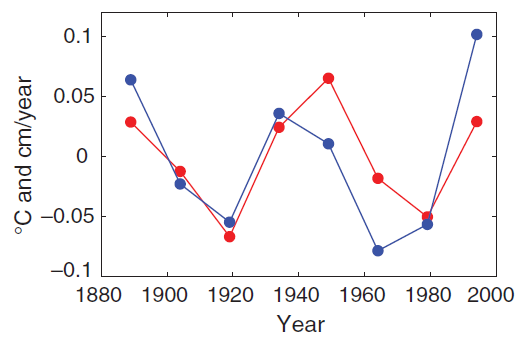
A topic that keeps coming up in the literature is the discussion on a (roughly) 60-year cycle in sea level data; a nice recent paper on this is Chambers et al. in GRL (2012). One thing I like about this paper is its careful discussion of the sampling issue of the tide gauges, which means that variability in the tide gauges is not necessarily variability in the true global mean sea level (see Part 1 of this post). I want to add some thoughts on the interpretation of this variability. Consider this graph from my Response to Comments in Science (2007):


Fig. 1: Fifteen-year averages of the global mean temperature (blue, °C, GISS data) and rate of sea level rise (red, cm/year, Church&white data), both detrended.
[Read more…] about Sea-level rise: Where we stand at the start of 2013 — Part 2

References

  1. D.P. Chambers, M.A. Merrifield, and R.S. Nerem, "Is there a 60‐year oscillation in global mean sea level?", Geophysical Research Letters, vol. 39, 2012. http://dx.doi.org/10.1029/2012GL052885
  2. S. Rahmstorf, "Response to Comments on "A Semi-Empirical Approach to Projecting Future Sea-Level Rise"", Science, vol. 317, pp. 1866-1866, 2007. http://dx.doi.org/10.1126/science.1141283

Filed Under: Climate Science, Communicating Climate, Instrumental Record, IPCC, Oceans

Sea-level rise: Where we stand at the start of 2013

9 Jan 2013 by Stefan

Progress has been made in recent years in understanding the observed past sea-level rise. As a result, process-based projections of future sea-level rise have become dramatically higher and are now closer to semi-empirical projections. However, process-based models still underestimate past sea-level rise, and they still project a smaller rise than semi-empirical models.

Sea-level projections were probably the most controversial aspect of the 4th IPCC report, published in 2007. As an author of the paleoclimate chapter, I was involved in some of the sea-level discussions during preparation of the report, but I was not part of the writing team for the projections. At the core of the controversy were the IPCC-projections which are based on process models (i.e. models that aim to simulate individual processes like thermal expansion or glacier melt). Many scientists felt that these models were not mature and understated the sea-level rise to be expected in future, and the IPCC report itself documented the fact that the models seriously underestimated past sea-level rise. (See our in-depth discussion published after the 4th IPCC report appeared.) That was confirmed again with the most recent data in Rahmstorf et al. 2012.
[Read more…] about Sea-level rise: Where we stand at the start of 2013

References

  1. S. Rahmstorf, G. Foster, and A. Cazenave, "Comparing climate projections to observations up to 2011", Environmental Research Letters, vol. 7, pp. 044035, 2012. http://dx.doi.org/10.1088/1748-9326/7/4/044035

Filed Under: Climate Science, Instrumental Record, IPCC, Oceans

  • « Go to Previous Page
  • Page 1
  • Interim pages omitted …
  • Page 3
  • Page 4
  • Page 5
  • Page 6
  • Page 7
  • Interim pages omitted …
  • Page 10
  • Go to Next Page »

Primary Sidebar

Search

Search for:

Email Notification

get new posts sent to you automatically (free)
Loading

Recent Posts

  • Unforced Variations: June 2026
  • “The Arctic Council is not dead”
  • Scenarios, schmenarios…
  • Unforced Variations: May 2026
  • Unforced Variations: Apr 2026
  • A reflection on reflection

Our Books

Book covers
This list of books since 2005 (in reverse chronological order) that we have been involved in, accompanied by the publisher’s official description, and some comments of independent reviewers of the work.
All Books >>

Recent Comments

  • Paul Pukite (@whut) on Unforced Variations: June 2026
  • Paul Pukite (@whut) on Unforced Variations: June 2026
  • jgnfld on Unforced Variations: June 2026
  • Julian on Unforced Variations: June 2026
  • patrick o twentyseven on Unforced Variations: June 2026
  • patrick o twentyseven on Unforced Variations: June 2026
  • Joke Zonderkop on Unforced Variations: June 2026
  • Joke Zonderkop on Unforced Variations: June 2026
  • Joke Zonderkop on Unforced Variations: June 2026
  • patrick o twentyseven on A reflection on reflection
  • Ron R. on Unforced Variations: June 2026
  • Tomáš Kalisz on Unforced Variations: June 2026
  • Barton Paul Levenson on Unforced Variations: June 2026
  • Ray Ladbury on Unforced Variations: June 2026
  • zebra on Unforced Variations: June 2026
  • Silvia Leahu-Aluas on Unforced Variations: June 2026
  • MA Rodger on Unforced Variations: June 2026
  • Paul Pukite (@whut) on Unforced Variations: June 2026
  • Joke Zonderkop on Unforced Variations: June 2026
  • Julian on Unforced Variations: June 2026
  • Nigelj on Unforced Variations: June 2026
  • Radge Havers on Unforced Variations: June 2026
  • Tomáš Kalisz on Unforced Variations: June 2026
  • Nigelj on Unforced Variations: June 2026
  • Julian on Unforced Variations: June 2026
  • Paul Pukite (@whut) on Unforced Variations: June 2026
  • zebra on Unforced Variations: June 2026
  • Ray Ladbury on Unforced Variations: June 2026
  • Harold Pierce, Jr. on Unforced Variations: June 2026
  • Nick Stokes on Unforced Variations: June 2026

Footer

ABOUT

  • About
  • Translations
  • Privacy Policy
  • Contact Page
  • Login

DATA AND GRAPHICS

  • Data Sources
  • Model-Observation Comparisons
  • Surface temperature graphics
  • Miscellaneous Climate Graphics

INDEX

  • Acronym index
  • Index
  • Archives
  • Contributors

Realclimate Stats

1,408 posts

15 pages

251,710 comments

Copyright © 2026 · RealClimate is a commentary site on climate science by working climate scientists for the interested public and journalists.