As the climate monitoring groups add an additional dot to their graphs this week, there is some disquiet among people paying attention about just how extraordinary 2023 really was.
[Read more…] about Not just another dot on the graph?Oceans
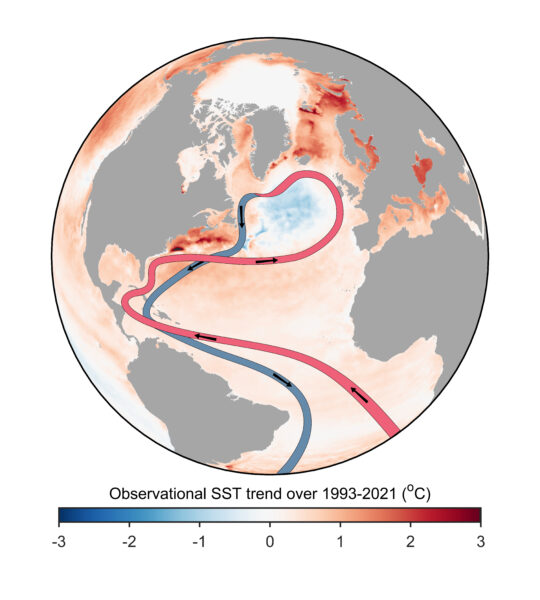
What is happening in the Atlantic Ocean to the AMOC?
For various reasons I’m motivated to provide an update on my current thinking regarding the slowdown and tipping point of the Atlantic Meridional Overturning Circulation (AMOC). I attended a two-day AMOC session at the IUGG Conference the week before last, there’s been interesting new papers, and in the light of that I have been changing my views somewhat. Here’s ten points, starting from the very basics, so you can easily jump to the aspects that interest you.
The CO2 problem in six easy steps (2022 Update)
One of our most-read old posts is the step-by-step explanation for why increasing CO2 is a significant problem (The CO2 problem in 6 easy steps). However, that was written in 2007 – 15 years ago! While the basic steps and concepts have not changed, there’s 15 years of more data, updates in some of the details and concepts, and (it turns out) better graphics to accompany the text. And so, here is a mildly updated and referenced version that should be a little more useful.
[Read more…] about The CO2 problem in six easy steps (2022 Update)Overselling k-scale? Hmm
Some of the authors of a recent commentary on k-scale modeling respond to RealClimate.
[Read more…] about Overselling k-scale? HmmThe Rise and Fall of the “Atlantic Multidecadal Oscillation”
Two decades ago, in an interview with science journalist Richard Kerr for the journal Science, I coined the term the “Atlantic Multidecadal Oscillation” (AMO) to describe an internal oscillation in the climate system resulting from interactions between North Atlantic ocean currents and wind patterns. These interactions were thought to lead to alternating decades-long intervals of warming and cooling centered in the extra-tropical North Atlantic that play out on 40-60 year timescales (hence the name). Think of the purported AMO as a much slower relative of the El Niño/Southern Oscillation (ENSO), with a longer timescale of oscillation (multidecadal rather than interannual) and centered in a different region (the North Atlantic rather than the tropical Pacific).
Today, in a research article published in the same journal Science, my colleagues and I have provided what we consider to be the most definitive evidence yet that the AMO doesn’t actually exist.
[Read more…] about The Rise and Fall of the “Atlantic Multidecadal Oscillation”Surprised by the shallows – again
Guest commentary from Jim Acker (GSFC/Adnet)
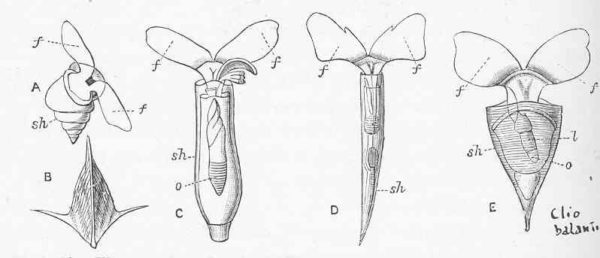
Research on the ocean carbonate cycle published in 2019 supports results from the 1980s – in contrast to many papers published since then.
During my graduate school education and research program in the 1980s, conducted at the Department of Marine Science (now the College of Oceanography) of the University of South Florida in St. Petersburg, I participated in research on the production (biogenic calcification) and fate of calcium carbonate (CaCO3) in the open waters of the northern Pacific ocean. There were two primary aspects of this research: one, to measure the sinking flux of biogenic materials in the water column of the Pacific Ocean, and two, to measure the dissolution rates of aragonite, a CaCO3 crystal structure (polymorph) formed by pteropods, under in situ conditions of temperature, pressure, and seawater chemistry.
New Ocean Heat Content Histories
Guest commentary from Laure Zanna (U. Oxford) and G. Jake Gebbie (WHOI)
Two recent papers, Zanna et al. (2019) (hereafter ZKGIH19) and Gebbie & Huybers (2019) (hereafter GH19), independently reconstructed ocean heat content (OHC) changes prior to the instrumentally-based records (which start ~1950). The goals (and methodologies) of the two papers were quite different – ZKGIH19 investigated regional patterns of ocean warming and thermal sea level rise, while GH19 analyzed the long-term memory of the deep ocean – but they both touch on the same key questions of climate forcing and response.
[Read more…] about New Ocean Heat Content HistoriesReferences
- L. Zanna, S. Khatiwala, J.M. Gregory, J. Ison, and P. Heimbach, "Global reconstruction of historical ocean heat storage and transport", Proceedings of the National Academy of Sciences, vol. 116, pp. 1126-1131, 2019. http://dx.doi.org/10.1073/pnas.1808838115
- G. Gebbie, and P. Huybers, "The Little Ice Age and 20th-century deep Pacific cooling", Science, vol. 363, pp. 70-74, 2019. http://dx.doi.org/10.1126/science.aar8413
Bending low with Bated breath
“Shall I bend low and in a bondman’s key,
Shylock (Merchant of Venice, Act 1, Scene 3)
With bated breath and whisp’ring humbleness…?”
As dark nights draw in, the venerable contrarians at the GWPF are still up late commissioning silly pseudo-rebuttals to mainstream science. The latest, [but see update below] which no-one was awaiting with any kind of breath, is by Dr. Ray Bates (rtd.) which purports to be a take-down of the recent #SR15 report. As Peter Thorne (an IPCC author) correctly noted, this report is a “cut-and-paste of long-debunked arguments”. I’ve grown a little weary of diving down to rebut every repetitive piece of nonsense, but this one has a few funny aspects that make it worthwhile to do so.
When they go low, we go “sigh…”.
[Read more…] about Bending low with Bated breathThe long story of constraining ocean heat content
Scientists predicted in the 1980s that a key fingerprint of anthropogenic climate change would be found in the ocean. If they were correct that increases in greenhouse gases were changing how much heat was coming into the system, then the component with the biggest heat capacity, the oceans, is where most of that heat would end up.
We have now had almost two decades of attempts to characterize this change, but the path to confirming those predictions has been anything but smooth…
[Read more…] about The long story of constraining ocean heat content
Resplandy et al. correction and response
Guest commentary from Ralph Keeling (UCSD)
I, with the other co-authors of Resplandy et al (2018), want to address two problems that came to our attention since publication of our paper in Nature last week. These problems do not invalidate the methodology or the new insights into ocean biogeochemistry on which it is based, but they do influence the mean rate of warming we infer, and more importantly, the uncertainties of that calculation.
[Read more…] about Resplandy et al. correction and response
References
- L. Resplandy, R.F. Keeling, Y. Eddebbar, M.K. Brooks, R. Wang, L. Bopp, M.C. Long, J.P. Dunne, W. Koeve, and A. Oschlies, "Quantification of ocean heat uptake from changes in atmospheric O2 and CO2 composition", Nature, vol. 563, pp. 105-108, 2018. http://dx.doi.org/10.1038/s41586-018-0651-8