We previously highlighted Roy Spencer’s poor practices in comparing models with observations, but we’ve now dug down a little deeper, and it’s not pretty.
A few weeks ago, the email exchanges of the CWG authors were published after a court ordered them to be made public. In them, there is an interesting exchange between Steve Koonin and Roy Spencer. Koonin wanted Spencer to address the (obvious) complaint that Roy’s comparison of ‘Corn Belt temperature trends’ figure was a cherry pick.
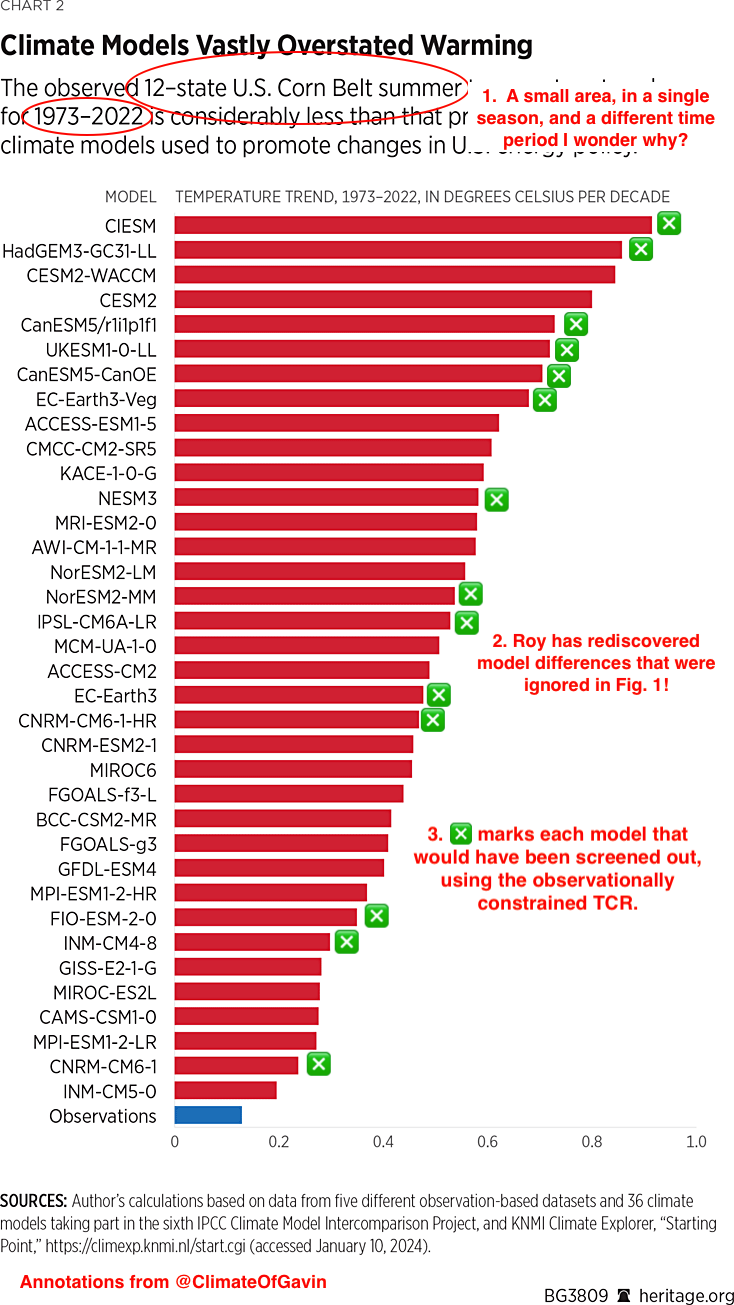
Roy agrees to look into it, but whether he ever got back to Koonin is unclear. In any case, no public statements or responses have been made. The conversation did however reveal where the data came from and Roy’s method for making the comparison, inspiring me to try and replicate the analysis more appropriately. So let’s see what we can find out.
NOAA Climate Divisions
NOAA has a great website with its Climate Division data (ClimDiv) which is an aggregated product from the individual station data, but averaged at the division, state, and regional levels. It has averages for 9 regions of CONUS, the big river basins, NWS areas, and multiple agricultural regions. The Corn Belt map for averages is below:
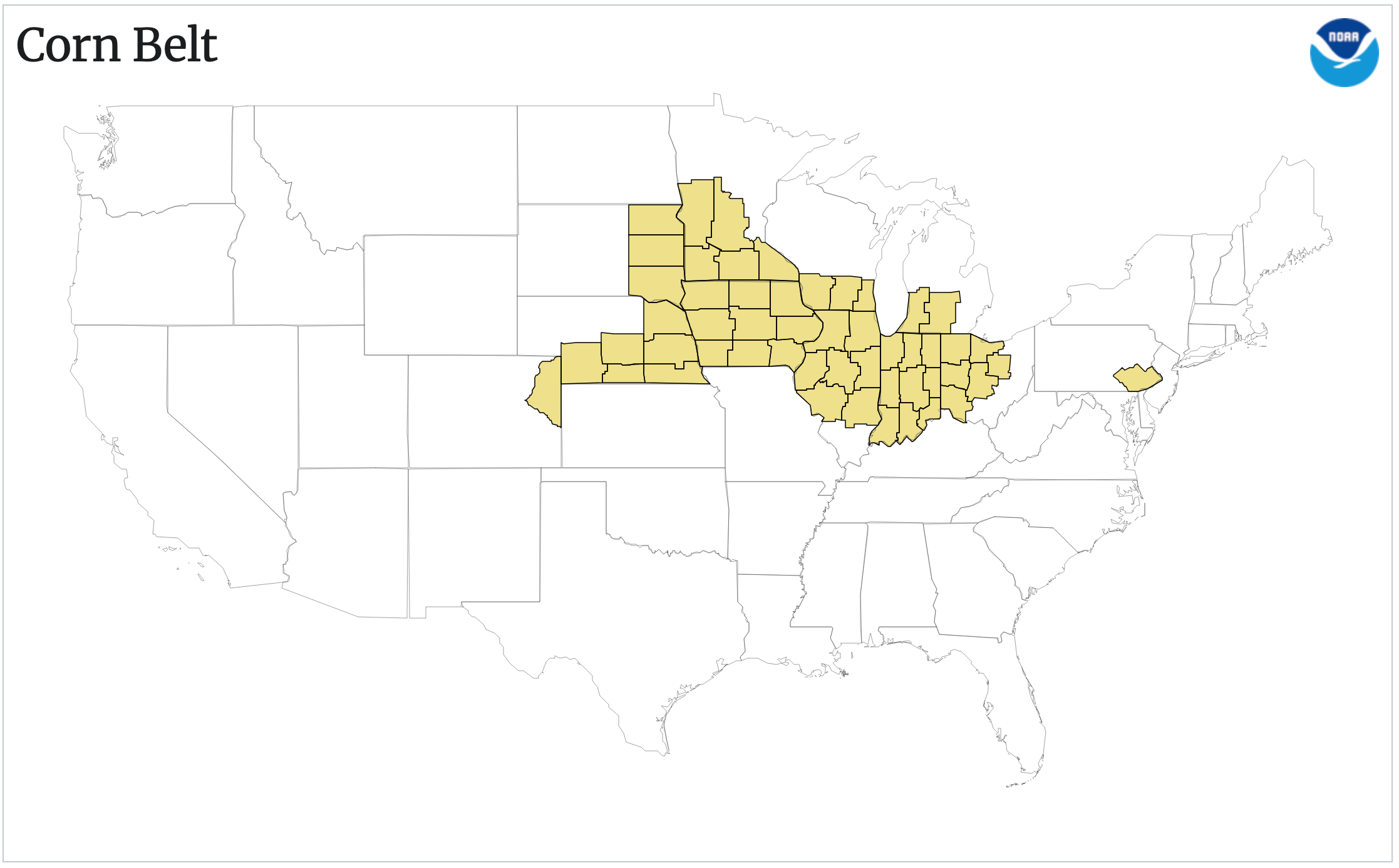
Spencer most likely used this precomputed index (across 11 states, though his figure says 12 – he might have tried making his own 12-state index but I don’t think it matters much, other than making it trickier to replicate). Anyway, the Corn Belt data (code 261 for the area weighted observational data) can be downloaded directly and the JJA trends computed for the 50 year period 1973-2022 (following Spencer’s graph). I’m sure it will come as a great shock to our readers that of all the regions computed in the NOAA ClimDiv dataset over this period, the Corn Belt index has almost the lowest summer trend (0.1ºC/dec though with a wide (95%) confidence interval [-0.07,0.27]). Quel surprise!
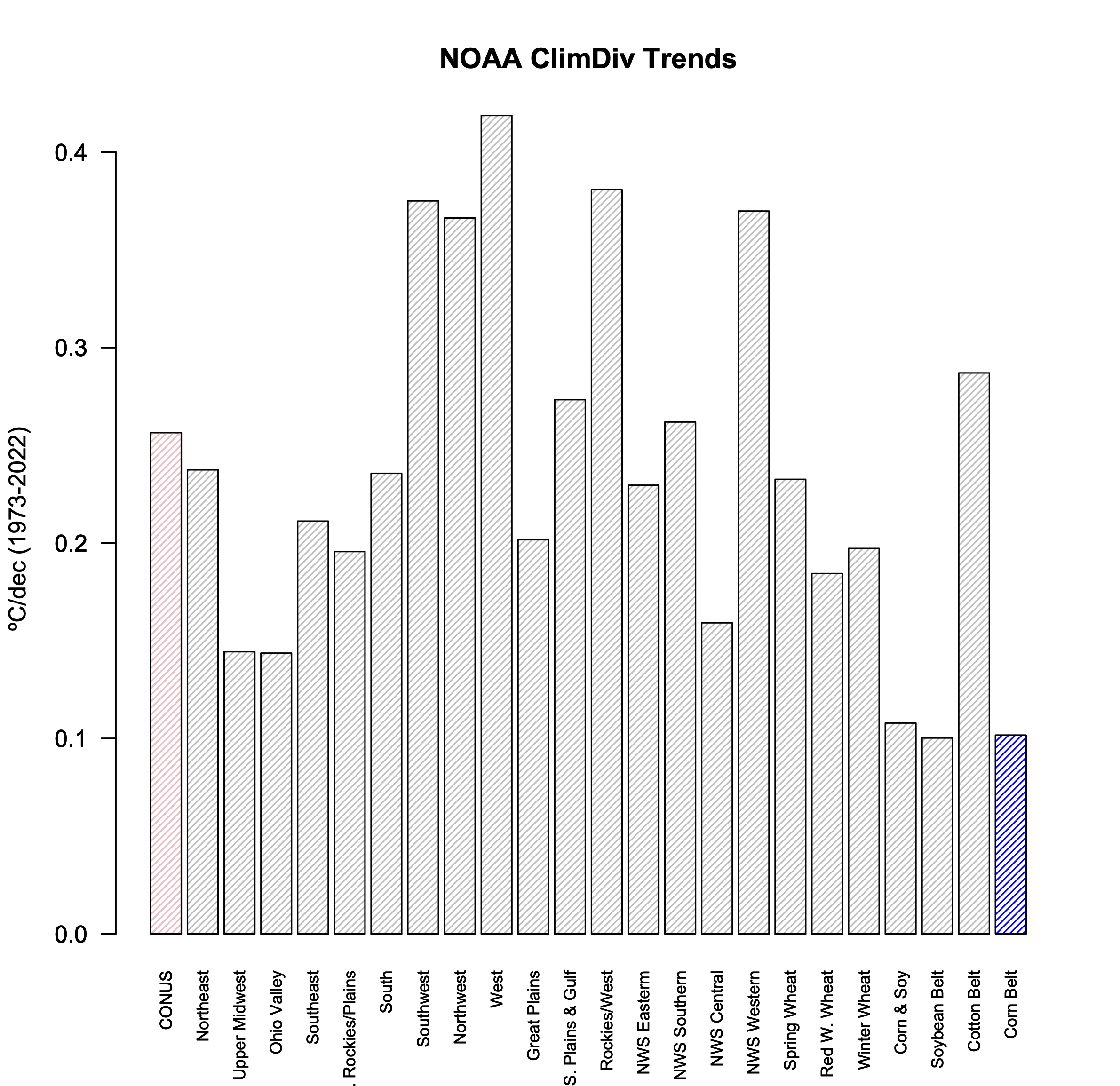
Note that the annual trends are much less noisy and more similar across the regions (but that wouldn’t be as useful, now, would it?).
This can be compared with the CMIP6 models data from a roughly analogous area (100-81ºW, 40-46ºN). This is relatively easy to extract from the ClimateExplorer website for 144 individual simulations (using the historical + SSP245 scenario). Spencer (I think) chose the option to download the ensemble mean for each model (or perhaps just a single run from each model). In either case, he discards very relevant information from the ensemble for each particular model.
So let’s plot the JJA trends for the Corn Belt region, including two elements that Spencer ignored. First, the uncertainty in the OLS trend in the observations (which is large) and, second, the spread across the individual model ensembles. As we did previously, we can plot the trends against the climate sensitivity (here I’ll use the Transient Climate Response) to see the difference that the ‘hot models’ make (IPCC AR6 assessed that the likely range of TCR was 1.4-2.2ºC, very likely 1.2-2.4ºC). Note that noisier the statistic (short periods, small regions, etc.) the less clear any difference related to climate sensitivity will be.
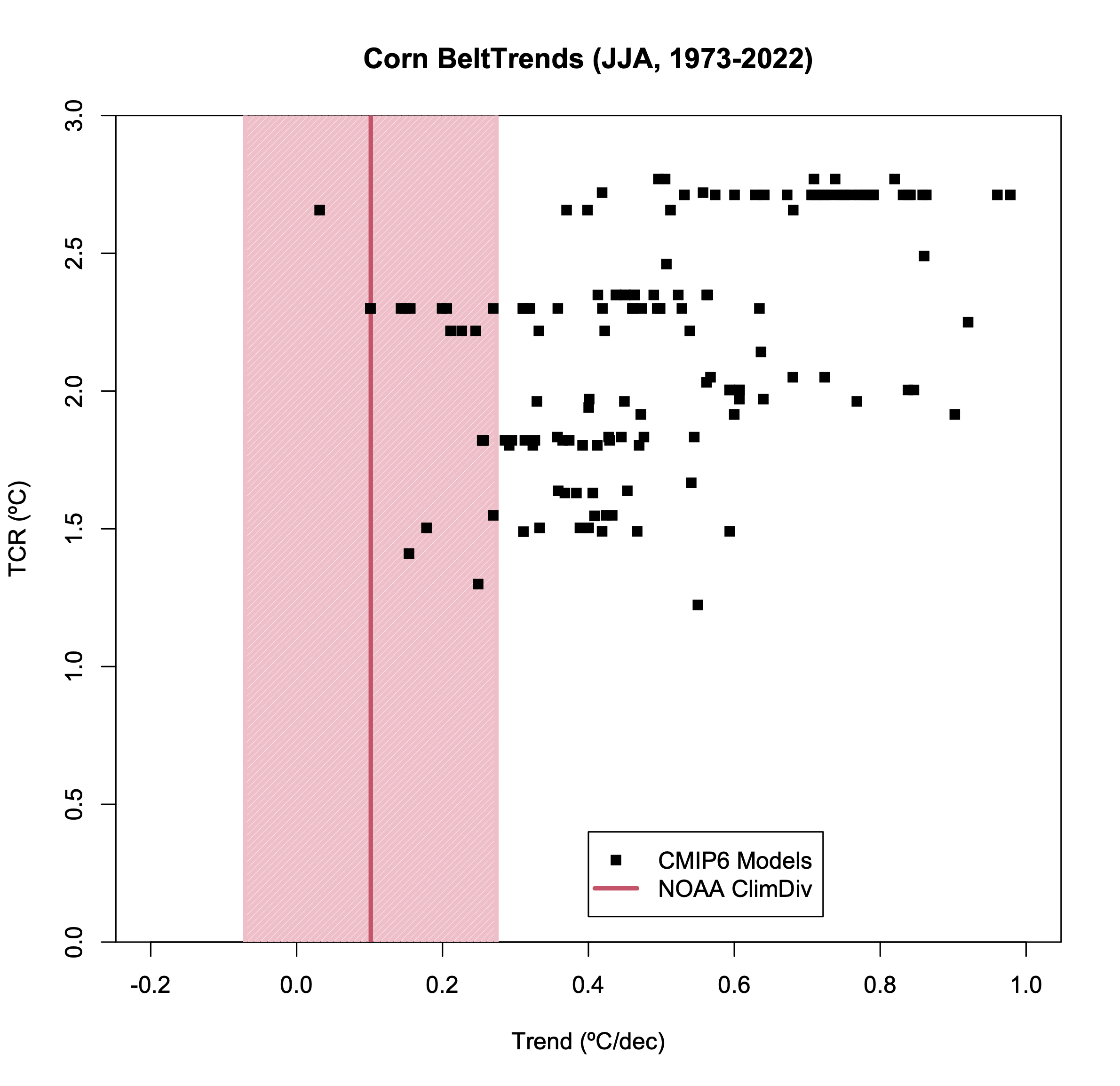
As in Spencer’s original plot, the bulk of the simulations have a larger trend than observed (all but 2 in fact). However, we are not done. Recall that the simulations are an ensemble of opportunity. Some of the models have sufficient ensemble members to reasonably estimate the standard deviation and the 95% spread for the trend in that model, but others have only one member and no spread can be calculated. If we assume that the average standard deviation (in this diagnostic it’s 0.11ºC/dec), is a good estimate in those cases, we can plot the ensemble means, along with an estimated 95% spread, for each model.
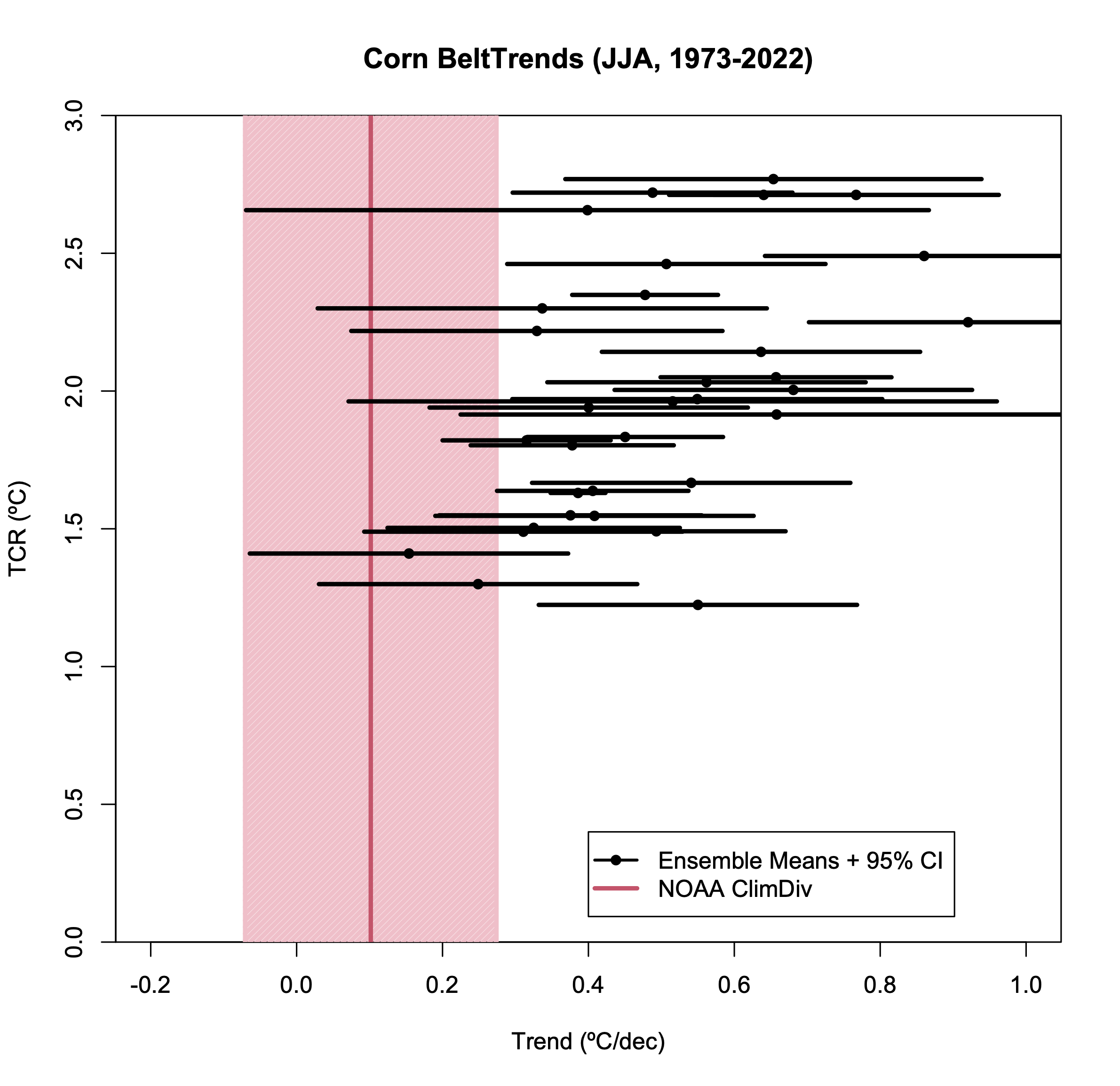
Now we have a slightly more regular statistical comparison, and we can see that this observation is within the 95% spread of about half a dozen models. Thus it’s a plausible (if not likely) match. Given the large number of comparison one could theoretically do, if one area (specifically chosen) is an outlier is not so surprising.
However, the point of the criticism of Spencer’s figure to begin with was not that these Corn Belt temperature trends have been well predicted, but rather that this index was cherry picked to provide the worst possible comparison. So what would a different index have given? I have not checked them all [The other crop regions are not so easily translated into lat/lon rectangles!], but I did look at the NorthWest region (124-111ºW, 42-49ºN) – this region has warmed more than the CONUS average by about the same degree that the Corn Belt region was below.
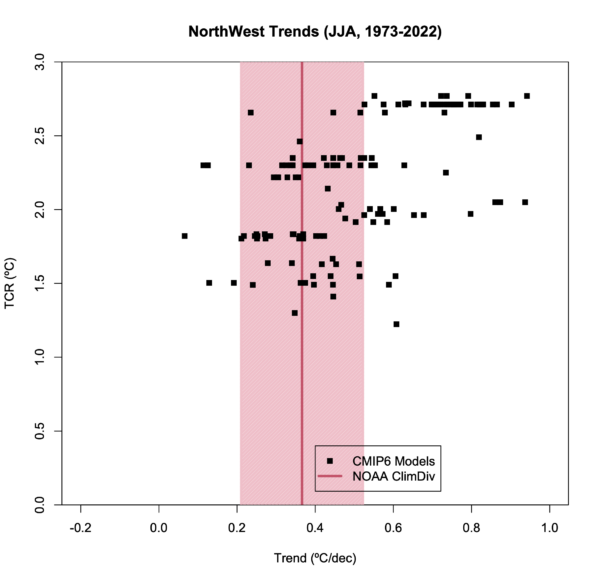
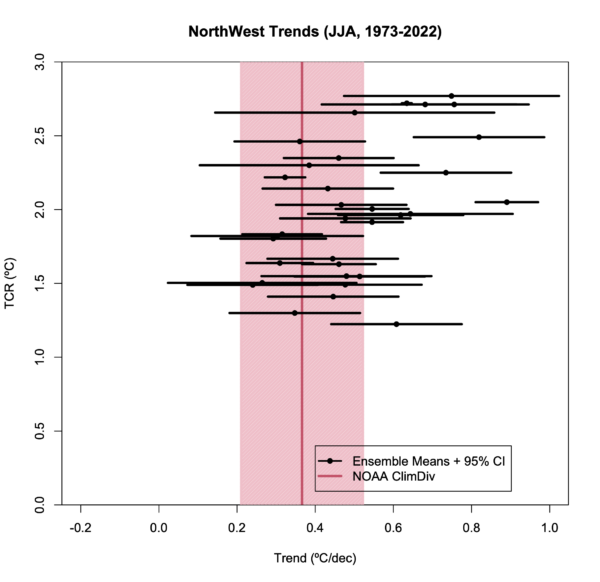
And… there is a much stronger coherence with the ensemble. But this would not have provided as useful a talking point of course. Does this mean the models are perfect? Of course not. A worthwhile analysis would have looked at a spread of such comparisons and made a statement about the utility of the models based on that collective analysis. Just looking at the one or two small areas or single seasons is not going to be informative.
Useful vs. Useless model-observation comparisons
My point here is not to discuss the utility of the CMIP6 projections for the corn, wheat, soy regions of the US etc. That is best left to people who have better domain knowledge about those applications. However, I do want to (again) stress a few points:
- Observations have uncertainty too. Whether it is in the linear trend and/or structural, it needs to be accounted for in any comparison.
- Observational data comes from a single realization. You need to think about what the irreducible uncertainty associated with internal variability means.
- The model ensembles are complex. You cannot substitute what is easily downloadable from ClimateExplorer for an analysis in and of itself.
- Whether the observed trend is or is not close to the model ensemble mean(s) is not a good test of the skill of the model(s) or multi-model ensemble.
- The appropriate test is whether the real world observation is exchangeable with an ensemble member from the model. The visual comparisons shown above address this, but it can also be done quantitatively in ways that take into account both the observational uncertainty and spread.
- Comparisons such as presented by Spencer in the DOE or Heritage Foundation reports are fundamentally flawed since they never deal seriously with any of this, and will continually be called out as cherry picking.
One last thought. Steve, take a moment and think about why Roy didn’t ever address the critiques. Just spitballing here, but the intersection between people generally thought of as ’eminent’ scientists and folks that engage in this kind of hackery is empty.

The corn belts cooler than expected surface temperature trend may be because Irrigation has expanded considerably over the decades. Can’t see how models could allow for things like that. So Spencer has picked the worst possible region. And no this doesn’t mean irrigation is the answer to global warming.
I doubt that irrigation is the main contributor to the slow summer temperature rise in the corn belt, because it is widely practiced only in the western fringes of the area. This would be the western parts of the eastern climate divisions of Nebraska and South Dakota, and further west. Most of the large scale center pivot irrigation – which is supported by aquifer drawdown – is located in areas outside the identified corn belt that are nevertheless being used to grow corn.
It might be that the more intensive cultivation of corn (both area and density) is altering regional evapotranspiration in a way that results in lower midsummer temperatures. Native grasses and spring crops such as rye and oats tend to reach peak evapotranspiration in June, then dry down in the summer. Corn utilizes copious water all summer, and doesn’t begin to dry down until August.
in Re to Nigelj, 4 Apr 2026 at 5:17 PM,
https://www.realclimate.org/index.php/archives/2026/04/spencers-shenanigans-part-ii/#comment-846792
and John Pollack, 5 Apr 2026 at 5:53 AM,
https://www.realclimate.org/index.php/archives/2026/04/spencers-shenanigans-part-ii/#comment-846799
Hallo Nigel, hallo John,
Thank you for your interesting remarks!
I think higher summer evapotranspiration (and, possibly, also higher direct evaporation from the soil surface?) in the corn fields (in comparison with meadows or grain fields) may be consistent with the note by Dean Rovang, 5 Apr 2026 at 5:53 AM,
https://www.realclimate.org/index.php/archives/2026/04/spencers-shenanigans-part-ii/#comment-846810
that winters in the studied region seem to warm rather quickly. I suppose that in winter, the cooling effect of the latent heat flux may be negligible in comparison with summer.
Greetings
Tomáš
Hello, Tomáš.
When I break down the corn belt trends further, they are at least consistent with the idea that summer ET has increased. Of course, there could be other causes, and the trend data will have more statistical noise.
I find that June temperatures continued to rise during the 1973-2022 period. So did precipitation. This reflects a warming climate. However, in July and August, the mean temperature and precipitation were essentially flat. Interestingly, the mean minimum temperature showed a slight increase, but the maximum had a very slight decrease during those months. The diurnal range was decreasing by about 0.15C/decade. This would be consistent with increased ET that slightly lowered daytime temperatures, but also resulted in higher absolute humidity. The summer minimum is often limited by high dew points.
In the winter, the cooling effect of the latent heat flux is indeed negligible in this region. A much larger factor would be the positive feedback from decreasing snow cover. Winter snow not only reflects incoming LW radiation, but also radiates more effectively in the IR and insulates the air from the warmer ground below. Snow cover enhances minimum temperature extremes. Winter snow cover in the region is frequent, but intermittent. Changes in the snow cover would increase an underlying climate warming trend.
John Pollack,
I always appreciate your more detailed and localized inputs, particularly because you bring in the relationship of the stats to the physics.
Could you clarify this sentence?
“Winter snow not only reflects incoming LW radiation, but also radiates more effectively in the IR and insulates the air from the warmer ground below.”
There has to be some complicated math involving the depth of the snow and the temperature gradient, yes? And the depth of the snow obviously affects the intermittency of the coverage? Lots of details.
Thanks, Zebra.
The math for the effect of snow cover is definitely complex. As forecasters, we resorted to crude rules of thumb, instead. For clear skies and light to moderate winds, we subtracted about 5F (3C) from the temperature we would otherwise forecast for thin but continuous snow cover, less if there are bare spots. The maximum effect was about 10F (6C) for fresh snow cover of 4 inches (10cm) or greater and very light or calm winds.
Snow provides effective insulation, and even a fairly thin layer of fresh powdery snow will really cut the temperature. Part of the temperature effect is also due to the high reflectivity of new snow to sunlight, in contrast to exposed ground.
Of course, snow cover has the most feedback on average temperature change when it is frequent but intermittent. If it is rarely present or rarely absent, variations aren’t changing the average much. However, I suspect that a significant factor in the unprecedented March heat wave centered in the southwest U.S. was an unusual lack of mountain snow cover. This allowed the ground to warm faster at higher elevations than usual, providing direct heat to the atmosphere and intensifying the heat dome.
John Pollack
Once again, I can’t get the experts to do my work for me! Crude rules of thumb indeed!
Seriously, I’ve been thinking about the question from the opposite direction. I have a building with a passive geothermal slab foundation/floor, and I’m wondering to what extent snow is a positive or negative effect on the internal temperature. My guess is that it is a net plus, but I’m not completely sure how much it depends on the time of year.
It’s of no great importance in terms of the cost of heating; it’s just a physics problem that interests me but I am too lazy to get into details. The design works great in the summer, of course, requiring no AC even through the hottest stretches.
But thanks for the info.
“And no this doesn’t mean irrigation is the answer to global warming.”
And likely moot in this case as in so many others just in regards to practicality. Recharge of the Ogallala Aquifer isn’t offsetting drawdown and degrading water quality,
A few weeks ago, the email exchanges of the CWG authors were published after a court ordered them to be made public
I suspect they’ll be more careful in the future.
One wonders how they will communicate. Burner phones? Smoke signals?
I guess there’s always traditional mail which I THINK is still protected free speech these days (but maybe not in this case?). There’s also Signal, but I don’t know if that would be protected. Anyway I suppose if there’s a will there’s a way. How do people in high places do these things? (Not saying it’s right).
There’s always The Cone Of Silence :D
https://www.youtube.com/watch?v=TxmEtJ31Ldw
Gavin’s point about cherry-picking summer in the Corn Belt is well taken — and it’s worth noting that the winter signal in that same region tells a dramatically different story.
I grew up in Decorah, Iowa, and learned to ski at a small local ski area there. It has since closed, citing lack of consistent snow cover through the winter season. I always suspected this was climate signal rather than noise, and I recently looked into the data.
Waterloo, Iowa — about 60 miles from Decorah — ranks 4th among 244 U.S. cities analyzed by Climate Central for winter warming since 1970, at +6.8°F. The Upper Midwest as a region leads the nation at +5.4°F average winter warming, nearly 40% above the national average of +3.9°F.
It’s worth noting that Climate Central’s analysis uses meteorological winter (December–February only). A Midwest ski area doesn’t just need cold in January — it needs to open by Thanksgiving and survive into March. March warming in the Upper Midwest has been just as dramatic as the core winter months, so the +6.8°F figure is almost certainly a conservative floor for the full operational ski season. The number that actually killed that ski area is probably larger.
This is precisely the season Spencer chose to ignore. The Corn Belt’s summer trend may be an outlier on the low end, as Gavin shows — but its winter trend is an outlier on the high end. A complete picture requires both. Cherry-picking region, season, and metric can make the same geographic area look like evidence against warming or evidence for it, depending on what serves the narrative. The honest analysis — as Gavin demonstrates — shows the full distribution.
Should never argue by anecdote. Use hard data whenever possible. Minnesota is at the northern range of the corn belt but is solid corn (corn, oats, alfafa, soybeans but no wheat). Look at this set of data that I have been monitoring for awhile now — spring ice-out dates of Minnesota lakes.
https://geoenergymath.com/2026/01/27/minnesota-ice-out-update/
Have to group these by latitude to discriminate the mean temperature of the region but the overall warming is clear. The overall average is around -0.08 days earlier per year which amounts to 8 days earlier ice-out over 100 years. Taking for example the difference of average temperatures between April 1 and April 8, this is 1.8℃
The anecdote was the motivation, not the evidence. The evidence was Climate Central’s analysis of NOAA station records showing Waterloo, Iowa ranking 4th among 244 U.S. cities for winter warming at +6.8°F since 1970 — which I cited in the same comment.
This year’s Minnesota ICE-OUT dates are slightly earlier than expected. Many of the dates at 44 and 45 N latitude are sooner than the 90-day mark (~ April 1), which is the regression fit for 44N
see the real-time updates coming in for higher latitudes here:
https://www.dnr.state.mn.us/ice_out/index.html
Fine debunking another one in the endles queue of climate ignoramuses – as I prefer to call the denialists, because you can’t “deny” there is a thing called climate and nobody does that. What the ignoramuses do, is just ignoring what science tells us climate is and does, simply because it does not fit their “economic” fairy tales about the endless blessings of fossil fuels.
But: *why does the queue of climate ignoramuses never end?* Why is debunking them another neverending work of Sisyfos’s, going on and on and on, while the world is hotting up even faster? While the battle is being lost, while leading climatologists are expecting the average temperature on Earth’s surface (2 meters above, I know, calm down) to come hurtling by 1,5 degrees C above preindustrial in just a few years from now (no point in debating exactly when. It’s like debating intensely why the atomic bomb was thrown over Nagasaki on august 9th at this and not that hour. It’s what you call an academic exercise)?
Well, that’s obvious:
1) fossil capital has enormous funds and is paying the climate ignoramuses – producers of nonsensical climate doubt – very well, as documented by many researchers, first and foremost Naomi Oreskes in her excellent book “Merchants of doubt”. Just check out the Heritage Foundation, Cato Institute etc. and all their subsidiary “companies” like “The Heartland Institute”, financing among others a few danish astrophysicists (especially Henrik Svensmark, see this typical page https://notrickszone.com/2019/01/22/munich-conference-leading-danish-astrophysicist-says-solar-activity-has-significant-impact-on-global-climate/ ) and climate ignoramuses with fx. the debunked theory about the connection between solar activity, cloud formation and climate, which researchers are paid by them etc. Common feature for all these “theories” is exactly one thing: they are willing to accept any theory about recent global warming, except one: that CO2 and other gas emissions stemming from the burning of fossil fuels has anything whatsoever of importance to do with this.
You don’t have to be Sherlock Holmes to understand why that is so. So why are we still debating this so intensely? Aren’t there much more important issues to work on and discuss for climate scientists and the public?
F.x. why are we underestimating the *consequences* of the ongoing – paleoclimatologically seen extremely fast – global temperature increase? Probably not experienced in tens of millions of years or even more by life on Earth? By now it seems that the 1,5 degree-world will be much more dangerous than hitherto understood. The propaganda of “adaptation” is trying to make us ignore this completely, because fossil capital thinks it won’t be paying the huge costs, it’ll be the taxpayers, and they are secured from that by the rule of Trump, Thiel etc.,,their wars, Putin’s wars etc.
This is what people experience, so I find research on this must be heavily prioritized.
2) Climate geophysics is not easy understandable to most people. Thus it’s very easy making them believe all sorts of seemingly intuitive “truths” about how good CO2 is for us all, how extremely little influence is has upon the climate because there are just so tiny amounts of it in the atmosphere (troposphere is the precise expression, but most people don’t know what that is) etc. Most people don’t even know what logical argumentation is. They simply believe what they feel fits their day-to-day life best. So therefore cheap gas: good, CO2 taxes: bad, climate scientists who say otherwise and tell us things that don’t sound good, like a risky future: bad, really bad, evil and nutty professors etc.
3) Given the media-industrial complex and who owns it, the end result is given. George Orwell told us why in his novel “1984”, and so did Neil Postman in “Amusing ourselves to death” (1985, an interesting year…) about what I will call the Reagan-Bush silent coup against what little was left of democracy after two centuries of mythologies about “the founding fathers”, the “checks and balances” (Trump now demonstrates how easy it is for the executive “branch” – in fact it’s the core of the state, not a “branch”, and it’s controlled by the president, not by accident betitled “the commander in chief” – to overrule all that by directives, manipulation, police-state methods etc.) emanating from the ruling tycoons. After they got rid of Roosevelts new deal by manipulating Harry Truman upon him when he was getting old and weak, the game was easy. Eisenhower woke up when he left the job, and Kennedy and his brother made some quarrels, but look where they ended up: same place as Stalin’s, Mao’s and now Putin’s, Netanyahu’s, Trump’s etc.s enemies.
4) Now after Musk’s DOGE coup d’etat, not the least cutting down and forbidding climate science, his oligarchic buddy Thiel’s Palantir artificial “intelligence” is taking over most vital functions controlling tax evations, how the bureaucracy works etc.: feudal, totalitarian capitalism is here once again, “surprisingly” as before accompanied by endless wars “for peace”. It first came along both with the de facto military dictatorship of general Ludendorff in Germany (july 1916-early november 1918, when it was for a short while overthrown by the revolt of workers and soldiers, but began to slowly creep back and succeded with Hitler 1933 after three years of “presidential dictatorship”, formally under the almost senile general Hindenburg, the old collegue of Ludendorff) and a few years later after Lenin’s coup in Russia 1917/18 with his proclamation of state capitalism there 1921 (economically a copy of the german war economy under Ludendorff), and the year after that with Mussolini’s fascist takeover in Italy assisted by the liberals. Where did Musk find his “roman” gesture after his edgelord Trump won the “election” – against the hapless celebrity show of his “apolitical” “opponent” paid for by some other oligarchs, who “surprisingly” also support big oil, Israel etc., like their chief idiologist H. Clinton, who btw also threatened to obliterate Iran on morning TV in the spring of 2008, when campaigning against Obama. “Strangely” such facts are never mentioned by the media, they just can’t “remember” them.
To conclude: it isn’t wise always just to fight on the terrain preferred by the enemy. The merchants of doubt and pseudoscientific mythologies will always have the upper hand concerning public understanding of any subject, especially complicated scientific subjects, as long as the media are controlled by the moneyed classes. And now they have even automated the lying industrial processes with A”I”… their lying “productivity” is enormous. As the saying goes: “the false rumour is running around the world while the truth hasn’t even begun to put on it’s shoes”. Mark Twain described this tactic – in our times excessively used by the fossil barons, Trump etc. – with his great satire about american elections: “Running For Governor” (1870)
https://americanliterature.com/author/mark-twain/short-story/running-for-governor https://storyoftheweek.loa.org/2012/11/running-for-governor.html?m=1 . This is just the whole “secret” of The Orange Liar in Chief and of all the climate ignoramuses. Why seems neither Bernie Sanders nor the whole liberal and socialist press etc. still not to have understood this fully? And not even many highly educated people? After almost 160 years? And almost hundred years after Goebbels? For me that is at least somewhat enigmatic.
“What the ignoramuses do, is just ignoring what science tells us climate is and does, simply because it does not fit their “economic” fairy tales about the endless blessings of fossil fuels.”
Ok “genius”..Try growing, fertilizing, harvesting and delivering food to all of the eight billion stakeholders without using vehicles that run on gasolines, as well as the agriculture required to make the ethanol for biofuels. It’s part of the “blessings” of an economy based on fossil fuels that has served us well for over a hundred years. Economic fairy tale or climate reality?
KT: Try growing, fertilizing, harvesting and delivering food to all of the eight billion stakeholders without using vehicles that run on gasolines…
MS: That is being done now, Ken, It’s only a matter of time. From Google AI:
Yes, it is possible to plant, grow, harvest, and deliver food crops to market using only electric vehicles (EVs) and equipment, though this is currently implemented primarily on specialized or pilot farms rather than large-scale industrial operations.
Current Capabilities by Stage
Planting and Growing: Electric tractors (e.g., Monarch MK-V, Solectrac) and robotic systems can perform plowing, tilling, and planting. Specialized electric machinery also handles irrigation and crop monitoring via autonomous drones.
Harvesting: Battery-powered harvesters are available for high-efficiency crop collection. In specific sectors like viticulture (vineyards) and orchards, full-electric straddle tractors are already replacing manual labor and diesel machines.
Delivery to Market: Electric utility vehicles (UTVs) and electric trucks are used to transport produce from fields to storage or local markets. For long-distance delivery, fully electric refrigerated trailers with battery-regenerating axles are now in production.
Real-World Examples
100% Electric Farms: A six-hectare cherry farm in New Zealand operates entirely without diesel, utilizing electric tractors for all tasks, including transporting the harvest to market.
Vertical and “Electro-Ag” Farms: Robotic vertical farms use wheeled robots to move crops within a fully automated, indoor system. New “electro-agriculture” research even explores bypassing photosynthesis by using electricity to grow crops in total darkness.
Remaining Challenges
Infrastructure and Range: Limited charging networks in rural areas and shorter battery life compared to diesel fuel remain barriers for massive, multi-thousand-acre operations.
High Upfront Costs: Electric tractors can cost 2 to 2.5 times more than diesel equivalents, though they offer 30–40% lower operating costs over time.
Power Requirements: Transitioning the entire U.S. food supply to electric systems would require massive upgrades to the renewable energy infrastructure.
Good points. The last and most important is “Remaining Challenges.” Unfortunately, stating the problem does not come close to summarizing either the science or the politics of “making it so.” The physical (as in physics) limitations on making any of these solutions happen to maintain anything close to current social and political-economic systems with a global population of 8 billion or more are ‘huge.” IMO, “impossible.”
This site is not IMO the place for a detailed exchange on the above ‘opinions.’ I recommend a few other sites and some research and learning:
• A venerable archive (http://theoildrum.com/special/archives) of eight years of dialogue regarding “peak oil” and related topics (e.g., net energy cliff—https://www.resilience.org/stories/2024-02-07/approaching-the-energy-cliff/)
• A twenty year long monthly compilation from many sources of pieces on our current political economy, https://www.pelicanweb.org/
• The Post Carbon Institute (https://www.postcarbon.org/), one of whose founders did a very clever short summary, “300 Years of Fossil Fuels in 300 seconds” (https://www.youtube.com/watch?v=cJ-J91SwP8w)
• And I can’t resist ending with another cartoon, this one focused on Buckminster Fuller’s insights about carbon based energy systems: https://stuartmcmillen.com/comic/energy-slaves/
TT: And I can’t resist ending with another cartoon, this one focused on Buckminster Fuller’s insights about carbon based energy systems:
MS: I am fortunate to live in Oslo where I have minimized my energy slave requirement. 100% of my personal transportation is walking, bicycle riding, and using public transport. The public transport in Oslo is nearly 100% electric, but a few diesel bus routes remain until chargers can be installed at the far ends. And the electricity is entirely renewably sourced, mostly hydroelectric, plus some wind. On the rare occasion I need a taxi, almost all the taxis are electric. Most delivery vehicles are electric. The electricity I use in my flat is hydroelectric. My hot water comes from a central source in the city; I’m not sure if they heat the water with gas.
I think Oslo is a good model for what all cities should strive for. The first step is to heavily incentivize use of public transport in cities, by improving public transport systems, by closing off city streets to private vehicles, and by taxing the use of private vehicles on city streets. The tax should be progressive so rich people pay a lot more than the rest of us for using their cars in the city.
Beyond that, the planet has way too many people, but the global fertility rate has dropped dramatically over recent the decades. It is now about 2.2 or 2.3, which is very near the replacement rate of 2.1. More than half the nations of the world are below this rate, so their populations would be decreasing were it not for migration from the nations that are still above the threshold.
I imagine that as the problems of global warming increase disproportionately in the places where the fertility rate remains high, either girls will eventually be educated and will choose to have fewer children, or, cruelly, the number of infant and mother deaths will increase from heat and lack of food and water.
Meanwhile, the global conversion of most ICE vehicles to EVs continues.
in Re to Martin Smith, 5 Apr 2026 at 8:53 AM,
https://www.realclimate.org/index.php/archives/2026/04/spencers-shenanigans-part-ii/#comment-846814
Dear Martin,
I have heard that soil compaction by heavy agricultural machinery may contribute to soil degradation. In this respect, I would like to ask if the present electro-machinery is lighter or rather heavier than fuel-powered machinery of a comparable performance. If it tends to become heavier due to unfavourably low energy density of batteries in comparison with fuels, are there efforts to design the electrical machinery differently than the fuel-powered one, so that soil compaction will not worsen or, more preferably, will rather decrease?
Another question:
So called agrivoltaics can be brought into practice e.g. by integrating vertical solar panels into fields and/or meadows. In such case, I can imagine that the weight of any moving machinery designed for such integrated facilities could be reduced by replacing batteries or fuel tanks by a suitable means for direct electricity supply from these solar panels. Are you perhaps already aware of some efforts or achievements in this direction?
Greetings
Tomáš
Tomáš, I suspect you are right about the soil damage from heavy equipment rolling over it repeatedly, but I haven’t looked at this problem. However, the problem of heavy batteries is being solved with Circle Farming. I entered this in the Google search box: If agricultural fields were organized as a matrix of large circular plantings, electric cables could be buried out to the center of each circle, and then EV machinery could run off electricity by cable, thus eliminating the need for onboard batteries.
Cutting and pasting Google AI’s responses doesn’t maintain the format anymore for me, so I recommend entering that string yourself, or something like it. The explanation of Circle Farming is quite good.
Martin… I was responding to the lengthy rant from KVJ.
All of that progress was made possible by using transportation fuels. It will take decades to finish the e energy transition to renewables and EVs. That obviously means more CO2 will be added with little being captured and stored.
KT: It will take decades to finish the e energy transition to renewables and EVs. That obviously means more CO2 will be added with little being captured and stored.
MS: Yes, Ken, it IS obvious, so you don’t need to keep repeating it.
KT: ” It will take decades to finish the e energy transition to renewables and EVs. That obviously means more CO2 will be added with little being captured and stored.”
You’re stating the obvious, and repeating yourself for the hundredth time. You’re like a parrot: “Polly wants a cracker, Polly wants a cracker, Polly wants a cracker…..” Why don’t you say something constructive for once, rather than spreading apathy and repeating yourself.
And at least by building renewables and EVs we hugely reduce the amount of CO2 that would be added to the atmosphere in total this century. And we don’t have to capture and store all the CO2. We only have to remove just enough to stop dangerous levels of climate change. We could capture the excess CO2 if we really wanted. There are all sorts of ways to do this. DAC, rock weathering, tree planting, regenerative agriculture. None of these are silver bullets but they all add together.
KT: All of that progress was made possible by using transportation fuels. It will take decades to finish the e energy transition to renewables and EVs. That obviously means more CO2 will be added with little being captured and stored.
BPL: I am a one-note man/I play it all I can.
kt, All of that progress was made possible by using transportation fuels. It will take decades to finish the e energy transition to renewables and EVs. That obviously means more CO2 will be added with little being captured and stored
Or we could be there MUCH sooner if the FF companies and their lackeys in congress and the current maladministration didn’t keep trying to KILL clean energy.
https://www.theguardian.com/us-news/2025/oct/10/trump-officials-drop-major-solar-power-project-in-another-renewable-energy-attack (and lots of others).
Fortunately some voices in that camp are starting to wake up. Renewable, particularly solar, is obvious. It’s kind of dumb to ignore, and for stupid political reasons no less, a free energy that just falls around us like ripe fruit from a tree. And as it’s taken up in earnest prices for initial installation will fall. You might be the last one left still advocating against renewables and for FF. Starting to hear an echo? Well there is still the flat earth society I guess. But wouldn’t you rather be in the forefront of this change?
https://www.csmonitor.com/USA/Politics/2026/0404/trump-republicans-solar-power-climate
https://newrepublic.com/post/207978/maga-solar-wind-trump
With time one expects that society will abandon destructive and obsolete FF altogether when that party finally accepts that global warming is also equally obvious.
Isaiah Berlin’s essay “The Fox and The Hedgehog” uses the dichotomy in that parable to classify thinkers: “The Fox knows many things, while the Hedgehog knows one very big thing.”
Ken Towe wants desperately to be acknowledged as a brilliant hedgehog. Unfortunately, to be a successful hedgehog, the one big thing one knows must be true, while Ken’s tired routine is based on fallacies and data that are at least a decade out of date–presumably the last time Mr. Towe bothered to look at the world around him.
The limitations on our ability to navigate the current climate crisis are not technical. Nor are they due to limited resources. The reason we will fail to meet the demands of the climate crisis and will likely suffer the worst effects thereof derive from our own cognitive frailties. Humans simply aren’t smart enough or honest enough or brave enough to confront reality
Ray asserts… “…while Ken’s tired routine is based on fallacies and data that are at least a decade out of date.”
Ray…Can you please point to some of these specific fallacies and data that are out of date?
Ken Towe,
Happy to oblige:
1) Non sequitur fallacy: The fact that fossil fuels are currently required to increase the share of energy supplied by renewables does not mean that fossil fuels must always be consumed to do so.
2).Argumentum ad antiquitatem: The fact that we now derive most of our energy from fossil fuels and have done so in the past does not mean that this approach is superior
3) Argument from Incredulity–the fact that you cannot imagine how we wean ourself off of fossil fuels says more about you ability to imagine than about our ability to do so.
As to data, you completely ignore the astounding progress made in renewables–progress that rivals what we saw with Moore’s law in electronics. In 1965, you no doubt would have said one could never hold a computer in your hand. And in 1899, you would have scoffed at ever being able to illuminate your home without whale oil.
KVJ, why do you need so many words to state the obvious??
Humans are apes. They have the capacity to act like Bonobos, but the circumstance of limited resources relative to population has produced a cultural evolution favoring the chimp model.
So yes, 100 years after Goebbels et al, despite some positive changes, enough of the population fits that paradigm to tip the balance towards the extreme of chimp-hood… authoritarian structures with identity group status as a paramount motivator.
Duh.
And here’s where I ask the question that never gets answered:
What’s your plan???
I think there are lots of smart people who understand this situation perfectly well. But solutions are often painful and involve sacrifice. Maybe you have not understood or forgotten the cost of ending Goebbels et al?
Understanding is one thing, having leverage is another.
This post topped my feed this morning
https://bsky.app/profile/climateofgavin.bsky.social/post/3miylsxj6t22z
hat tip to Gavin
Thinking there may be some response from Spencer on his blog, I took a look. Nothing.
So what is exercising them down at UAH?
Their TLT record posted its March numbers with a record high anomaly for the USA48 coming in at +3.7ºC. The previous record anomaly had been +2.4ºC which dated back to 2012, while 3rd is now the anomaly three months back (Dec 2025 = +2.1ºC), 4th 2017 (+2.1ºC), 5th way back in 1981 (+2.0ºC), while 6th was last month (Feb 2026 = +1.9ºC).
So March 2026 is a serious record-breaker and comes on the back of some seriously toasty months.
This USA48 March warmth has apparently been picked up in other records with Roy being told by his chum Johnno that “there has been considerable discussion amongst the state climatologists about March temperatures in the U.S.”
Thus Roy Spencer faced up to his keyboard to head off any thoughts by the media that this record 48USA March anomaly was “evidence for global warming” with a scholarly blog insisting that “the unusual (and likely record) warmth of March 2026 in the U.S. was largely due to normal month-to-month weather variations, while the large-scale climate signal shows March was a continuation of the slow (and largely benign, and possibly even beneficial) warming trend we have been experiencing in recent decades.”
The evidence he manages to muster for this bold assertion is that (1) Canada was cold in March and (2) we never hear about cool months being evidence against global warming and (3) “It is human nature to think the weather we experience has some sort of global significance.”
“Whether the observed trend is or is not close to the model ensemble mean(s) is not a good test of the skill of the model(s) or multi-model ensemble”
Wow!
So you suspect that Spencer chose this region for nefarious reasons. You say “I’m sure it will come as a great shock to our readers that of all the regions computed in the NOAA ClimDiv dataset over this period, the Corn Belt index has almost the lowest summer trend”
But then you say it is too hard to do the other crop regions as “The other crop regions are not so easily translated into lat/lon rectangles!”
Just maybe Spencer agrees with you
Double wow
And finally, the thrust of your post is that if you include confidence bars on some of the models, the results aren’t too bad
Triple wow
KW: And finally, the thrust of your post is that if you include confidence bars on some of the models, the results aren’t too bad
MS: That wasn’t “the thrust of [the] post. Not even close.
KW: But then you say it is too hard to do the other crop regions as “The other crop regions are not so easily translated into lat/lon rectangles!”
MS: “not easy” doesn’t mean “too hard,” and if it’s not too hard, then it should have been done. More to the point, why do the computation regionally? Why not do it for the entire continental US, like he often does?
KW quoting the author: “Whether the observed trend is or is not close to the model ensemble mean(s) is not a good test of the skill of the model(s) or multi-model ensemble” Wow!
MS: You didn’t say why you think that point is wrong.
Keith Woollard,
Separating your comment into three does not make it any more trenchant or correct.
Why would we expect the model ensemble mean to have any meaning whatsoever? What is the average of an orange, a pear and a plum? All fruits, but why do we expect them to come from a common, well behaved distribution?
Spencer is presumably trying to make a point with his corny observations. You would think maybe he would want to validate that point by looking at other grain-growing regions–separating the wheat from the chaff, as it were. Gavin is merely pointing out that selecting a single example that tells you what you want is cherry picking. It doesn’t matter that it may have been the first one you looked at.
And finally, yes, confidence levels are key to how science works. Maybe you should look into it.
Ray, go back and read a little more thoroughly. The only ensemble means discussed in this post are the multiple runs of the same model. At no point are averages done between models. We have discussed that here previously and I totally agree that averaging different models achieves nothing. Averaging model runs of the same model in a pseudo-monte-carlo approach does have mathematical meaning – it doesn’t improve accuracy, but it does have the ability to help understand the impacts of various parameters.
“You would think maybe he would want to validate that point by looking at other grain-growing regions” – Then why didn’t Gavin do that?????? Luckily (as I pointed out) Gavin explained why he didn’t do that.
I understand confidence levels and I wish more climate scientist would use them. But it’s a big stretch to suggest that Gavin’s 5th figure shows a better model-observation match than the 4th figure
Except that even looking at the same model, there is no reason to expect a single trial to be drawn from the midrange–and the same is true for reality. The only to assess agreement is to look at the variability of the models and where the data fall in relation to that ensemble.
And looking at the 95% CL is superior, because the ensemble will not reflect the expected variability if it includes only a couple of runs–let alone one.
And I’m sorry, but simply saying, “But that’s hard!” is not a sufficient excuse for failing to follow statistical rigorous best practices and then making a claim of significance. I would not that it is not Gavin making such a claim, but Spencer, so the onus of following through is on him. That is now science works, and Spencer ain’t doing it.
I notice he somehow “missed” those subsets of the data covering the whole annual cycle going the other way.
If he were trying to make a CLIMATE point, he wouldn’t, and couldn’t, choose 1 tiny area of the globe during one subset of months of the year.
So then the question to ask becomes: What exactly IS his point?
To my eyes he’s simply proven that when you do huge numbers of multiple comparisons you take away–and in this case also confound due to crop overlap–so many degrees of freedom you are mathematically certain to see some spurious “significant” results both ways.
Or, more simply, especially should you only report a single result out of many you must have checked into, you are cherrypicking.
jgnfld –
“I notice he somehow “missed” those subsets of the data covering the whole annual cycle going the other way.” – no, actually not going the other way.
“If he were trying to make a CLIMATE point, he wouldn’t, and couldn’t, choose 1 tiny area of the globe during one subset of months of the year. ” – no, He has written part of a report looking at the impacts of CO2 on the US. He chose the growing season in a region of fundamental importance AND he states clearly he chose it as it had “One of the largest discrepancies between models and observations is in the U.S.”
And Ray “even looking at the same model, there is no reason to expect a single trial to be drawn from the midrange” Correct, but assuming Gaussian distribution it is far far more likely to be drawn from near the middle than the extrema at either end. If Spencer had plotted every individual run of each model, his plot would have looked more similar to his original than to Gavin’s. The way Gavin has displayed is more deceptive as it gives as much credence to the endpoints as the bulk of the results
Spencer himself said why he chose the subset, the counter example Gavin cherry picked, and then displayed deceptively, still shows the models running hot. That is what realclimate scientists should be worried about.
You do understand how confidence intervals work, right? I mean, the question is whether there is anything noteworthy (at a given confidence), and if the confidence intervals overlap the data, the answer is “can’t say”.
“…still shows the models running hot. That is what realclimate scientists should be worried about.”
No, that is ONE thing they should be worrying about–along with whether models can bound the warming we expect going forward, given the data since 2020, and whether tipping points may introduce other discontinuities. Modelers have a whole lot of things to worry about–but I think they should start with the effects where statistical significance can be demonstrated.
And the last thing they should have to worry about is being blindsided by a star chamber appointed by a bunch of anti-science philistines bent on snuffing out science as an independent source of truth.
https://paulkrugman.substack.com/p/maga-is-winning-its-war-against-us
KW: he chose it as it had “One of the largest discrepancies between models and observations is in the U.S.”
BPL: In other words, classic cherry-picking.
Yup. He looked at scores/hundreds of possibilities and reported “one of the largest”. That’s the very definition of cherrypicking.
Surely you as the mentor to scientists you set yourself up as in your comments about what scientists should be doing are aware of such things.